It's my birthday today, if anyone cares to know. I am now 22 years old, and making my parents feel really old :-)
This year is pretty uneventful just like last year. (Yes, you heard right, my 21st birthday was uneventful; I am not a fan of alcohol.)
Just hung out a little yesterday with some friends, and wanted to get a Coldstone ice cream cake (soooo good!) but unfortunately they didn't have any made, so that was a pretty big bummer.
On another note, I am bringing three young Catholics from my school to a latin mass at my church for the first time, they have never been to one. I pray their experience will be positive, even if it may be a bit confusing, especially since they are coming on Ash Wednesday and not a regular Sunday mass. But I think it is important to expose as many young people to the EF of the mass. they need to know what came before them, and the Latin mass is probably the best way for them to SEE the traditions of their faith. Then they have a standard, in a sense, by which to compare the NO mass. Without that, have much will they really understand of the renewal and reform taking place in the Church? I am guessing not as much.
Also, my senior music recital is in... 5 days!!! time seems to be going by so quickly! My Dad will be coming down here to visit for the first time, which is exciting. Pray that i sing really well, Since I am recording it! It is a 1 1/2 hr-long recital, so i hope i don't get too fatigued.
Work to do now, paper due Wednesday related to C.S. Lewis' "The abolition of man" which is starting to make my brain feel like mush, but sort of in a good way. However, I am glad i am not a theology major!
Monday, February 4, 2008


Sunday, February 3, 2008
Feast of the Presentation of the Lord: Candlemas: The Purification of the BVM
This special and beautiful feast just occurred in the church calendar yesterday, and unfortunately in much of the Church in America went unnoticed! If some of you don't know, this feast is actually one of the most ancient revelatory feasts about our Lord, and also about our Lady, originating in Jerusalem? So why is it we don't celebrate it anymore? Why is it that priests do not encourage my their example and teaching? This feast gives us one of the best ties with the Eastern catholic Church, since it was spread from there to the West. However, much of that East-West connection has been lost, and i would like to show how. First i will answer the question of why: because of the simplifying "revisions" of "implementing" Vatican II.
Now i'm not saying the teachings of Vatican II are bad, and I won't get into all my views about the liturgical calendar as a whole, but i must say when i compared the liturgies of Feb. 2nd, old and new, i was disappointed in the new mass when it comes to celebrating this feast.
The biggest differences is at the very beginning of the feast celebration. Historically, meaning from the middle ages all the way up till 1962, there have been 5 orations (prayers) to bless the candles that use much symbolism of fire and light and how they express our faith and Christ. These prayers are ancient and of Eastern origin. Then the candles are incensed and sprinkled with holy water, and then distributed to the priests and laity. During the distribution the choir sings the canticle of Simeon (Nunc dimittis) and the antiphon"Lumen ad revelationem gentium et gloriam plebis tuæ Israel" is sung after every verse until all the candles are passed out and lit. Then as the procession starts (going outside), the choir sings the antiphon "Adorna thalamum tuum, Sion", composed by St. John of Damascus, one of the few pieces which, text and music, have been borrowed by the Roman Church from the Greeks. The other antiphons are of Roman origin. The solemn procession represents the entry of Christ, who is the Light of the World, into the Temple of Jerusalem. there is a certain chant that is begun upon the congregations reentry into the church, and then the mass began right away and followed the structure of any normal mass with all the proper chants, Kyrie, gloria, etc.
Now compare this with the "new" liturgy: The 5 ancient orations have been done away with and replaced with one simple prayer. Not only that, but the candles are not all first blessed and then given to the people, they are handed out to the people and THEN blessed, which is really an odd way of blessing something! This also then means that the canticle of Simeon is NOT sung while candles are being passed out, the chant with its antiphon is not part of the ritual at all! There is actually a whole new created chant that is suggested to be sung, even though it is way to short to accompany the passing out of the candles. Also, how is the priest supposed to sprinkle all the candles with holy water when everyone is holding them first. Thankfully, the "Adorna..." chant is retained to be sung during the procession, but the one upon reentering the church has been changed to just chanting the introit, even though techincally, the procession is not yet done. Then, probably one of the strangest things, is that the missal says the Kyrie should be ommitted! (but the gloria is still sung). I have NEVER BEFORE seen instructions in a mass for the Kyrie to be omitted. the gloria, yes, during penitential seasons, but the Kyrie??
One last smaller difference: In the older rites, the people were to again hold their candles lit through the proclamation of the Gospel (and also throughout the whole Canon i believe), which is removed in the new rite.
So many rich meaningful prayers, rituals, and symbols have been lost!! Celebrating candlemas in the new rite of the mass can still be beautiful, but if done according to the books, it lacks A LOT of depth compared to the rich historical rituals and prayers that it used to have. Although, i have to wonder if you could change some things so that the structure looks more like the traditional structure in the beginning. I know you probably couldn't just ADD the 5 orations in, but maybe you could possibly bless all the candles together, and just sing the nunc dimittis anyway as candles are being distributed. And maybe you could just sing the old reentry chant anyway, THEn the introit, and hold lit candles during the gospel. maybe I am wrong in hoping that such changes could just be done, but i don't see how it would harm anything, if anything it would help to give the whole blessing and processional more coherence and structure.
Oh, one last thing: supposedly the priest can also choose right before distributing the candles, to give a short instruction about the meaning of the procession and the prayers, etc.
I pray that the Feast of the Presentation will someday become more celebrated in the church and will advocate for it to be done wherever I go, especially to have it done in the extraordinary form which makes evident the rich history of the feast and the East-West connection of the church much more clearly. It is a beautiful feast to be done in the evening on Feb. 2nd so that the candlelit procession is in the dark : - )
Now i'm not saying the teachings of Vatican II are bad, and I won't get into all my views about the liturgical calendar as a whole, but i must say when i compared the liturgies of Feb. 2nd, old and new, i was disappointed in the new mass when it comes to celebrating this feast.
The biggest differences is at the very beginning of the feast celebration. Historically, meaning from the middle ages all the way up till 1962, there have been 5 orations (prayers) to bless the candles that use much symbolism of fire and light and how they express our faith and Christ. These prayers are ancient and of Eastern origin. Then the candles are incensed and sprinkled with holy water, and then distributed to the priests and laity. During the distribution the choir sings the canticle of Simeon (Nunc dimittis) and the antiphon"Lumen ad revelationem gentium et gloriam plebis tuæ Israel" is sung after every verse until all the candles are passed out and lit. Then as the procession starts (going outside), the choir sings the antiphon "Adorna thalamum tuum, Sion", composed by St. John of Damascus, one of the few pieces which, text and music, have been borrowed by the Roman Church from the Greeks. The other antiphons are of Roman origin. The solemn procession represents the entry of Christ, who is the Light of the World, into the Temple of Jerusalem. there is a certain chant that is begun upon the congregations reentry into the church, and then the mass began right away and followed the structure of any normal mass with all the proper chants, Kyrie, gloria, etc.
Now compare this with the "new" liturgy: The 5 ancient orations have been done away with and replaced with one simple prayer. Not only that, but the candles are not all first blessed and then given to the people, they are handed out to the people and THEN blessed, which is really an odd way of blessing something! This also then means that the canticle of Simeon is NOT sung while candles are being passed out, the chant with its antiphon is not part of the ritual at all! There is actually a whole new created chant that is suggested to be sung, even though it is way to short to accompany the passing out of the candles. Also, how is the priest supposed to sprinkle all the candles with holy water when everyone is holding them first. Thankfully, the "Adorna..." chant is retained to be sung during the procession, but the one upon reentering the church has been changed to just chanting the introit, even though techincally, the procession is not yet done. Then, probably one of the strangest things, is that the missal says the Kyrie should be ommitted! (but the gloria is still sung). I have NEVER BEFORE seen instructions in a mass for the Kyrie to be omitted. the gloria, yes, during penitential seasons, but the Kyrie??
One last smaller difference: In the older rites, the people were to again hold their candles lit through the proclamation of the Gospel (and also throughout the whole Canon i believe), which is removed in the new rite.
So many rich meaningful prayers, rituals, and symbols have been lost!! Celebrating candlemas in the new rite of the mass can still be beautiful, but if done according to the books, it lacks A LOT of depth compared to the rich historical rituals and prayers that it used to have. Although, i have to wonder if you could change some things so that the structure looks more like the traditional structure in the beginning. I know you probably couldn't just ADD the 5 orations in, but maybe you could possibly bless all the candles together, and just sing the nunc dimittis anyway as candles are being distributed. And maybe you could just sing the old reentry chant anyway, THEn the introit, and hold lit candles during the gospel. maybe I am wrong in hoping that such changes could just be done, but i don't see how it would harm anything, if anything it would help to give the whole blessing and processional more coherence and structure.
Oh, one last thing: supposedly the priest can also choose right before distributing the candles, to give a short instruction about the meaning of the procession and the prayers, etc.
I pray that the Feast of the Presentation will someday become more celebrated in the church and will advocate for it to be done wherever I go, especially to have it done in the extraordinary form which makes evident the rich history of the feast and the East-West connection of the church much more clearly. It is a beautiful feast to be done in the evening on Feb. 2nd so that the candlelit procession is in the dark : - )
Saturday, January 19, 2008
My personal experience: the old mass affecting the new
Something i was thinking about today was the changes that the extraordinary form of the mass has caused in my liturgical and devotional life. It is interesting to note that for the first year of my encounter with the older form of the mass, it caused some confusion because of the great number of differences in the calendar structure and in the mass itself compared to the post-Vat. II calendar and liturgy. Also, because i had a pretty immediate attraction to the latin mass, i found going to the NO of the mass on weekdays to be frustrating at times as i came to understand better and better the richness of the EF of the mass.
However, i would like to say that i think (and hope) a balance is being reached in my life. I am still very much attracted to the EF mass, but it has now become a cause of enrichment of my experience of and participation in the NO of the mass. The EF mass, with its more set structure has given me a more solid foundation for truly praying the mass in union with the priest even when going to the NO of the mass. The EF mass has helped me to internalize the Eucharistic prayer, (or I prefer to always refer to it as THE Roman Canon) so that even despite the lack of quiet externally in a NO daily or weekend mass, i have been more easily able to foster that silence within by in a sense ignoring a lot of the spoken text of the priest in the NO of the mass because i have internalized his prayers and so unite my prayer with his. There are still times when this is hard, especially at daily masses when 1) Eucharistic prayer 2 is pretty much used by default, which makes me feel thrown into the consecration without preparation and hinders me from being able to properly offer the sacrifice and myself and my prayers with the priest to the Lord, and 2) when priests rush through this part of the mass, showing a lack of reverence and awe at this most powerful and mysterious sacramental reality taking place, especially when it can already be so short by use of Euch. prayer 2.
For me, there is one Roman canon. it is now imprinted upon my soul and i can pray no other at mass. I think that this is a special grace of the EF of the mass with its one set canon, which goes back at least to the 6th century. It has aided my internal prayer at the NO of the mass greatly.
Maybe this post will help even one priest to understand the power of the Roman Canon, or Eucharistic prayer 1.
However, i would like to say that i think (and hope) a balance is being reached in my life. I am still very much attracted to the EF mass, but it has now become a cause of enrichment of my experience of and participation in the NO of the mass. The EF mass, with its more set structure has given me a more solid foundation for truly praying the mass in union with the priest even when going to the NO of the mass. The EF mass has helped me to internalize the Eucharistic prayer, (or I prefer to always refer to it as THE Roman Canon) so that even despite the lack of quiet externally in a NO daily or weekend mass, i have been more easily able to foster that silence within by in a sense ignoring a lot of the spoken text of the priest in the NO of the mass because i have internalized his prayers and so unite my prayer with his. There are still times when this is hard, especially at daily masses when 1) Eucharistic prayer 2 is pretty much used by default, which makes me feel thrown into the consecration without preparation and hinders me from being able to properly offer the sacrifice and myself and my prayers with the priest to the Lord, and 2) when priests rush through this part of the mass, showing a lack of reverence and awe at this most powerful and mysterious sacramental reality taking place, especially when it can already be so short by use of Euch. prayer 2.
For me, there is one Roman canon. it is now imprinted upon my soul and i can pray no other at mass. I think that this is a special grace of the EF of the mass with its one set canon, which goes back at least to the 6th century. It has aided my internal prayer at the NO of the mass greatly.
Maybe this post will help even one priest to understand the power of the Roman Canon, or Eucharistic prayer 1.
Thursday, January 17, 2008
I actually have a few moments to make a post. I am not so stressed as i was at the beginning of the week. The Lord will give me the strength to deal with everything that he has placed before me if i remain faithful to Him and spend time in quiet with him. My greatest concern to start this semester has been that i won't have the time that i know i need alone with the Lord to grow in my relationship with him and deeper in love with him. So i pray that this concern does not become a reality by my own fault. I embark this semester with deeper thoughts about vocation and a call to search deeper within myself. I am coming ever closer to discovering the calling that God has placed within me of what i am called to be. My retreat in a cloister has provided much food for thought even if it wasn't the most enjoyable experience. I have learned several things. One, i know for sure i am not called to cloistered religious life, if i am called to live in community; two, i believe i have come out with a greater dependence on God, but it will need to be fostered continually by prayer and silence if it is to bear the fruits of humility and greater charity and all other virtues; three, that i had at least partially fallen into the modern trap of thinking of a vocation along the lines of what i am called to do rather than what i am called to be; fourth, this greater understanding of vocation has led me into a whole other level so to speak of my vocational discernment that is at once more complex and at times tiring because i just desire to know where I am called, but at the same time i am driven on for my heart will be restless until it rests in God; fifth, time needs to be taken this last semester to grow to a deeper understanding of my talents and what i do as the fruit of my vocation, and so converse with the Lord as to how the passions and talents that are rooted deep within me are to be part of my vocation or affect it; sixth, I have learned that there is also the Order of Virgins as a way of publicly being consecrated to the Lord but living in the world, which i will look into as well as religious communities; seventh, without community of some sort, of really close friends to share with each other our spiritual journeys, I become lost quite easily. Even if consecrated in the world, i would need at least 1 0r 2 people to share like this with.
And really there is probably much more that i have learned from having taken retreat, which will bear fruit in due time. May i remember to place all in the care of Our Lady.
And really there is probably much more that i have learned from having taken retreat, which will bear fruit in due time. May i remember to place all in the care of Our Lady.
Monday, January 14, 2008
Few posts
I will say now that I at least know that until after May, my posts will probably be few and far between. I'm in my last semester of college, with 18 credits, a senior recital in 4 weeks, 2 classes requiring traveling off campus, and job searching to do for after i graduate. Things will be a bit stressful. for any of you who read this blog, say a prayer for me! I'm going to need it, i already am feeling the stress, and it's only the first day back...
Wednesday, December 12, 2007
My Senior Music Recital
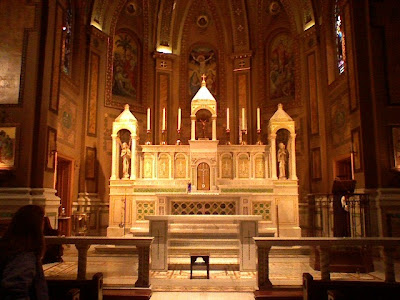
I just thought I would share the fact that my Senior music recital is less than two months away now! I am very excited for it, it really encapsulates so much of my college experience. It is longer than most as well, but i wanted it that way. All my pieces are vocal, with two each in German, French, and Italian, and multiple in English and Latin. I will be singing twelve songs for voice and piano that I have learned in my voice lessons over the course of the past 4 years, as well as 8 other pieces. Four will be Gregorian chants from the season of Lent, and 3 Renaissance polyphony pieces (2 by Palestrina, one by Guerrero) and one homophonic choral piece by William Croft. So total, i have 20 selections in my recital, which will be about an hour and a half with an intermission. I could not imagine having done a senior recital without singing chant and polyphony, especially considering the place i will be singing in, which is probably the best part of it all. Below are some pictures of the Sanctuary of St. Malachy's Parish in Philadelphia, probably the oldest Irish Catholic church in the city. It is mainly a poor black congregation that attends there now. The Sanctuary is absolutely gorgeous as you can see and the whole church just begs to have chant and polyphony sung in it, the acoustics were built for it. The rest of the Church is not enormous, which makes it ideal for my recital, so it is a little more intimate. I very much look forward to singing for all my family and friends, but primarily for God, in such a magnificent place of Catholic worship that probably has not heard such music in its walls for many years. My recital is planned for February 9th, and will be recorded by a friend from my parish, Mater Ecclesiae.

Saturday, December 8, 2007
The Immaculate Conception
It was really great for the first time to sing polyphony that I myself picked for the choral mass, and to have it go well. It was a really satisfying feeling. We sang a wonderful choral mass of the settings of the ordinary by Palestrina and a motet by Hassler for the feast of Our Lady's Immaculate Conception today, as well as hymns for the congregation: Daily daily sing to Mary, O Sanctissima, and Immaculate Mary. I certainly hope the high mass at the cathedral in Burlington went beautifully well last night.
I got to spend some time with my good friend Anja today since she came to sing alto for the mass with us. We got to talk alot about liturgy and the music in different places, and just views on things liturgical, which was nice.
I was thinking today, that i honestly believe that, if you planned a choral mass for a feast day in the church, and did it welll, i think you would have few if any complaints about it. instead, i think it would open many people's hearts and minds to beauty in the liturgy and let them have a glimpse of how beautiful and sacred and reverent their worship can be, especially with the right music. I just can't see how people could complain after hearing Palestrina, it's so beautiful and can seem to lift you right into heaven. Once getting a chance to just experience an immensely beautiful liturgy, I think it could change a lot of hearts and minds about it. Just my thought. Maybe i'm naive and too hopeful.
I got to spend some time with my good friend Anja today since she came to sing alto for the mass with us. We got to talk alot about liturgy and the music in different places, and just views on things liturgical, which was nice.
I was thinking today, that i honestly believe that, if you planned a choral mass for a feast day in the church, and did it welll, i think you would have few if any complaints about it. instead, i think it would open many people's hearts and minds to beauty in the liturgy and let them have a glimpse of how beautiful and sacred and reverent their worship can be, especially with the right music. I just can't see how people could complain after hearing Palestrina, it's so beautiful and can seem to lift you right into heaven. Once getting a chance to just experience an immensely beautiful liturgy, I think it could change a lot of hearts and minds about it. Just my thought. Maybe i'm naive and too hopeful.
Subscribe to:
Posts (Atom)


